The Illusion of Separation
Distinction does not require division — nothing stands alone, and the body corrects the great illusion through every breath, every meal, every heartbeat, and every act of love.
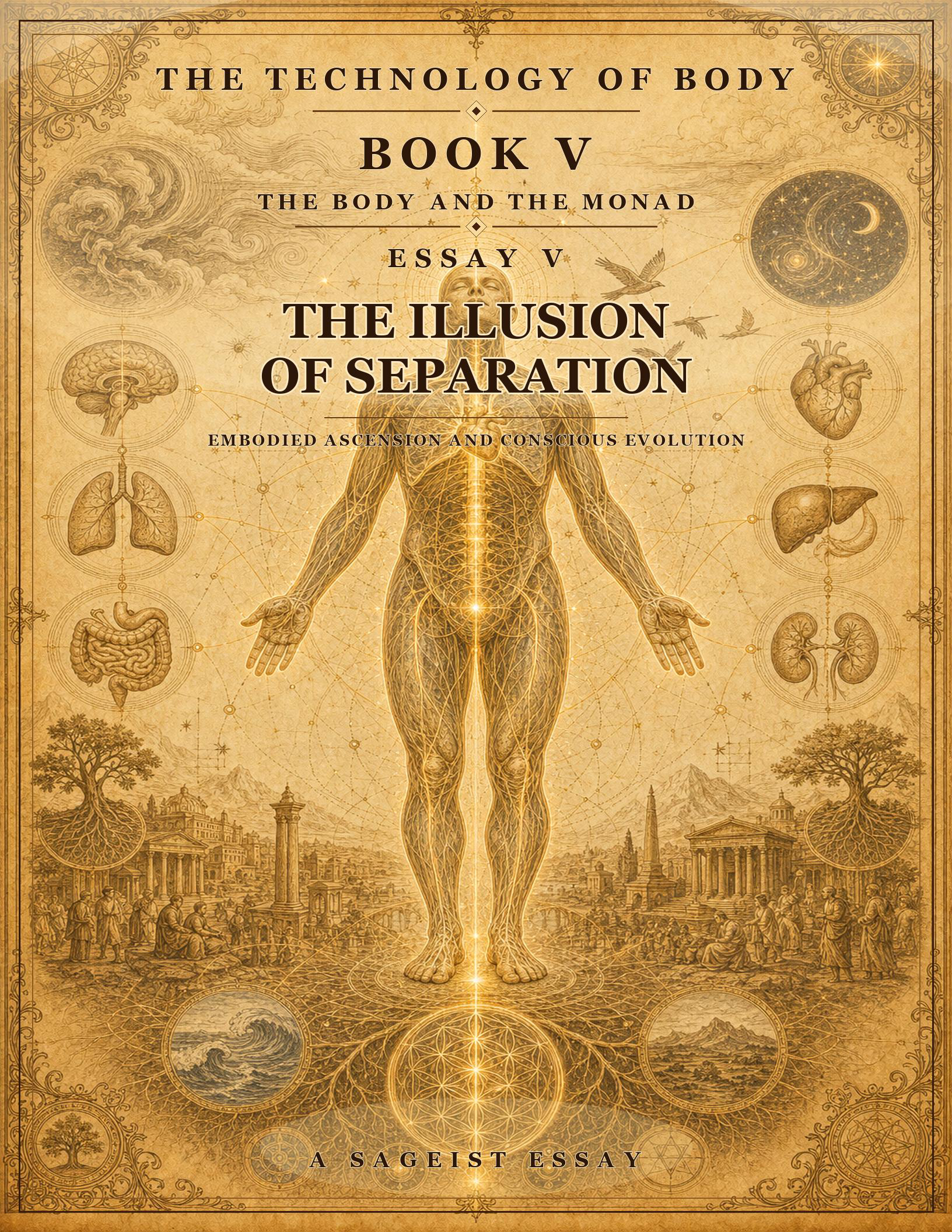
Modern civilization teaches fragmentation. Mind separated from body. Spirit separated from matter. Individual separated from nature. Humanity separated from cosmos. Knowledge separated into departments. Labor separated from meaning. Technology separated from wisdom. Economics separated from ecology. Power separated from soul. The result is profound alienation.
Yet separation may be the great illusion. Not because difference is unreal, but because difference has been mistaken for isolation. A hand is not the heart. The lungs are not the spine. The nervous system is not the blood. Yet none exists alone. Distinction does not require division. Unity does not require sameness.
The body reveals continuous relationship. Breath connects organism and atmosphere. Food connects organism and earth. Emotion connects individual and community. Attention connects consciousness and environment. Touch connects skin and world. Sound enters the nervous system. Light enters perception. The body is not a sealed object moving through a dead exterior. It is an open field of exchange.
Nothing exists independently. Every cell depends upon the whole organism. Every organ depends upon circulation. Every breath depends upon air. Every meal depends upon soil, sun, rain, labor, seed, time, and death. Every thought depends upon a body alive enough to think. Every identity depends upon language, memory, relationship, culture, and recognition.
The illusion of separation begins when the mind abstracts the part from the whole and then forgets the abstraction was an instrument. Analysis divides in order to understand. This is useful. But when division becomes worldview, the living whole disappears. The person begins to mistake categories for reality.
Modernity became powerful through division. It separated disciplines, measured parts, isolated variables, specialized labor, and mechanized systems. These methods produced astonishing capacities. Yet the same intelligence, when disconnected from reverence, produced fragmentation. The world was dissected so thoroughly that its living unity became difficult to feel.
The body corrects this error. It refuses to live as isolated machinery. The heart requires lungs. The lungs require circulation. Circulation requires nourishment. The gut requires microbial life. The brain requires blood. The nervous system requires every other system. No organ survives independently. Health emerges through cooperation.
This cooperation is not sentimental. It is structural. The body does not maintain unity by denying difference. It maintains unity by coordinating difference. Each system has its own function, rhythm, intelligence, and boundary. Yet all participate in one organism. The body is a civilization of differentiated intelligences held in relationship.
Human civilization obeys the same principle. Isolation creates decay. Connection creates life. A city cannot survive without food systems, water systems, waste systems, communication systems, transportation systems, emotional systems, symbolic systems, and trust. A society is not merely a collection of individuals. It is a living field of interdependence.
The Monad itself appears individual. Each person experiences an inward center, a private continuity, a unique stream of sensation, memory, longing, and meaning. This individuality is sacred. Sageism does not dissolve the person into vague collectivism. The Monad matters. The individual center matters. But the individual center matures only through relation.
Consciousness exists relationally. No person develops in isolation. The infant needs breath, warmth, touch, gaze, milk, sound, rhythm, and protection. The child needs language, limits, affection, story, correction, and belonging. The adult needs purpose, community, truth, challenge, work, beauty, and love. Even solitude becomes meaningful only against the background of relationship.
The self is not manufactured alone. It is called forth. A face awakens the face. A voice awakens the voice. A boundary awakens selfhood. A wound shapes defense. A teacher awakens intelligence. A beloved awakens tenderness. A rival awakens strength. A community awakens responsibility. The human being is formed through encounter.
Ancient wisdom repeatedly emphasized unity. Not as abstract philosophy alone, but as lived reality. The breath of the world entered the body. The body belonged to earth. The stars guided time. The temple mirrored cosmos. The community gathered around ritual. The individual found identity within lineage, landscape, symbol, and sacred order.
This ancient unity was not always perfect. Ancient societies could be violent, hierarchical, fearful, and unjust. The doctrine does not romanticize the past. But many traditional worlds understood something modern civilization often forgets: a human being cannot be understood outside the web of relationships that sustains and shapes life.
The body demonstrates interdependence constantly. When one system fails, the whole organism responds. When the lungs struggle, the heart works differently. When the gut inflames, mood shifts. When sleep collapses, attention fractures. When grief enters the chest, posture changes. When fear governs the nervous system, perception narrows. Nothing inside the body is truly isolated.
The same is true psychologically. A hidden belief affects behavior. A wound affects relationship. A habit affects identity. A memory affects chemistry. A symbol affects courage. An environment affects attention. A culture affects desire. A civilization affects the nervous system. Inner and outer continuously shape one another.
The illusion of separation has produced suffering at every scale. Personally, it creates disembodiment. The mind tries to live apart from the body, then wonders why anxiety grows. Spirit tries to float above matter, then wonders why life becomes impractical. The individual tries to live without community, then wonders why loneliness becomes epidemic.
Ecologically, separation becomes extraction. Humanity imagines itself outside nature, then treats earth as inventory. Soil becomes resource. Forest becomes lumber. River becomes utility. Animal becomes product. Atmosphere becomes dumping ground. The body eventually receives the consequences because the body was never separate from the field it damaged.
Socially, separation becomes competition without coherence. People are taught to define themselves against one another, to measure worth through comparison, to seek safety through accumulation, to mistake status for belonging. The social body fragments into rival identities, isolated appetites, and nervous tribes. Trust decays because the whole is no longer felt.
Technologically, separation becomes disembodied intelligence. Information expands while wisdom thins. Connection platforms increase contact while weakening presence. Digital environments multiply signals while separating attention from body, relationship, and place. The person becomes everywhere and nowhere. The nervous system pays the price.
Economically, separation becomes abstraction from life. Numbers move faster than bodies. Profit separates from ecological cost. Labor separates from dignity. Consumption separates from consequence. Wealth separates from stewardship. The market forgets the organism it lives inside. When economics loses relationship, it becomes appetite institutionalized.
The Sageist diagnosis is clear: civilization collapses when intelligence loses soul. Soul is not ornament. Soul is relationship felt as sacred. It is the recognition that life is not merely a set of disconnected functions, but an interdependent field of meaning. Without soul, systems optimize parts while injuring wholes.
The body offers a different model. It teaches systems intelligence through living form. The body does not maximize the heart at the expense of the lungs. It does not allow one organ to hoard all blood. It does not call inflammation health because it is energetic. It does not confuse stimulation with vitality. It seeks dynamic coherence.
Dynamic coherence is not sameness. It is ordered relationship among differences. The immune system must defend without attacking the self. The nervous system must activate and rest. The gut must admit nourishment and reject poison. The heart must circulate without exhaustion. The endocrine system must signal without chaos. Health is relational precision.
Civilization requires the same. A healthy society must defend without becoming paranoid, trade without becoming exploitative, innovate without becoming disembodied, govern without becoming tyrannical, educate without manufacturing compliance, and preserve beauty without freezing evolution. It must coordinate difference without destroying unity.
The illusion of separation also distorts spirituality. When spirit is separated from matter, transcendence becomes escape. The body becomes inferior. The earth becomes temporary scenery. Daily life becomes distraction. Relationship becomes obstacle. Work becomes merely worldly. But if incarnation is sacred, then spirit must be discovered through matter rather than away from it.
Spirit does not become less sacred when it enters breath, food, touch, labor, architecture, ecology, sexuality, grief, aging, and death. It becomes accountable. The invisible must become visible. The Monad must learn to move through form. Unity must learn how to love multiplicity. The spiritual path becomes not rejection of the world, but right relationship with it.
This is the hidden meaning of embodiment. To be embodied is to accept relationship. The body cannot exist without world. It cannot exist without exchange. It cannot exist without boundary and openness together. Skin separates and connects. Lungs receive and release. The gut discriminates and assimilates. The heart circulates. The nervous system listens. The body is a doctrine of relational intelligence.
The mind often resists this because separateness creates the illusion of control. If the self is isolated, it can imagine itself sovereign in a crude sense. It can imagine that its choices affect only itself. It can imagine that consequences can be externalized. It can imagine that power is freedom from relationship. But this is immature sovereignty.
True sovereignty is not isolation. It is self-governance within relationship. The integrated human does not dissolve into the collective, nor retreat into sterile individualism. The integrated human stands as a centered Monad in conscious participation with body, family, culture, nature, technology, and cosmos. Center and relation mature together.
The body teaches this through every breath. Inhalation says: I receive. Exhalation says: I release. Neither can be permanent. To only receive is suffocation. To only release is death. Life exists through rhythm, exchange, reciprocity, and trust. Breath is the simplest proof that the individual is not sealed.
Food teaches the same lesson. The meal is earth translated into flesh. Grain, fruit, water, animal, mineral, sunlight, soil, farmer, cook, culture, and digestion become body. Eating is not merely consumption. It is communion with the field that sustains embodiment. A civilization that forgets this turns food into product and the body into consequence.
Emotion reveals relational existence with equal force. Human beings regulate one another. A calm presence can soften a room. An anxious leader can agitate an organization. A grieving family changes the atmosphere of a home. A fearful population changes a nation. Emotion is not merely private weather. It participates in collective climate.
Attention also binds self and world. What the person attends to becomes psychologically significant. What a civilization trains attention toward becomes culturally powerful. If attention is captured by outrage, the social body becomes inflamed. If attention is trained toward beauty, service, truth, and depth, civilization begins to remember soul.
The body, therefore, is not only the place where the illusion of separation is disproven. It is the instrument through which unity can be practiced. Breath practice restores relation to atmosphere. Movement restores relation to gravity. Nutrition restores relation to earth. Silence restores relation to attention. Service restores relation to community. Ritual restores relation to symbol.
The initiate does not merely believe in unity. The initiate practices relationship. This is the difference between philosophy and embodiment. A person may speak of oneness while exploiting others, neglecting the body, damaging the earth, or living in emotional isolation. Such speech remains decorative. Unity must become behavior.
Behavior is where the illusion breaks. If nothing stands alone, then every act enters the field. Speech enters nervous systems. Consumption enters ecosystems. Leadership enters institutions. Design enters posture. Media enters attention. Parenting enters memory. Architecture enters mood. Technology enters desire. There are no isolated actions.
This does not mean the individual must carry the whole world as guilt. That would create paralysis. It means the individual must live with conscious participation. Responsibility is not punishment. It is the dignity of belonging. The Sageist does not ask, how can I escape consequence? The Sageist asks, how can my life become coherent within the larger field?
The illusion of separation also appears within the person. Many people live as divided territories. Mind against body. Desire against discipline. Fear against love. Shadow against image. Past against future. Spirit against appetite. The inner world becomes a civil war. The body then reflects this war through tension, fatigue, compulsion, and fragmentation.
Integration begins by restoring relationship among the parts. The mind must listen to the body. The body must be guided by wisdom. Emotion must be heard without becoming ruler. Desire must be disciplined without being demonized. Shadow must be integrated without being enthroned. Spirit must descend into conduct. The Monad must gather the parts into order.
This gathering is not domination. The center does not heal the parts by silencing them. It listens, interprets, places, and coordinates. The fearful part needs safety. The grieving part needs witness. The desiring part needs direction. The angry part needs truth and boundary. The exhausted part needs restoration. Inner unity appears when the parts no longer compete for sovereignty.
The body knows this law. When one system overpowers the others, pathology begins. Inflammation meant to protect can become disease. Stress meant to mobilize can become depletion. Appetite meant to nourish can become compulsion. Thought meant to clarify can become rumination. A function becomes harmful when separated from the whole it was meant to serve.
This is why self-governance is relational rather than repressive. The Sageist does not crush the body to prove spiritual superiority. Nor does the Sageist obey every impulse in the name of authenticity. The initiate learns right relationship among forces. Hunger, sexuality, ambition, grief, intellect, intuition, aggression, tenderness, and devotion each require place within the larger order.
The same principle applies to institutions. When economics dominates education, the young become instruments of production. When technology dominates attention, the nervous system becomes raw material. When politics dominates truth, language becomes weaponized. When medicine forgets environment, treatment becomes partial. A system becomes destructive when it forgets the whole it exists to serve.
This is why Book V matters. Book I showed the body as technology. Book II showed the nervous system as consciousness interface. Book III showed symbolic physiology. Book IV showed initiation through embodied practice. Book V asks how the Monad becomes whole through incarnation. Wholeness begins when false separation dissolves.
Wholeness does not erase distinction. This point must be guarded carefully. A mature doctrine of unity respects boundary. The heart and lungs cooperate because each maintains its function. The individual and community flourish when each honors the other. Unity without boundary becomes confusion. Boundary without unity becomes isolation. Health requires both.
The Sageist therefore rejects two errors. The first error is fragmentation: everything divided, isolated, commodified, and alienated. The second error is collapse: everything blended without discernment, boundary, responsibility, or structure. True unity is ordered relationship. It is coherence among living differences.
Sophia is essential here. She is the intelligence of relation, beauty, harmony, receptivity, and regenerative design. Sophia teaches that connection must be felt, not merely declared. She reveals the subtle bonds among home, body, emotion, architecture, ecology, and soul. Without Sophia, unity becomes a concept. With Sophia, unity becomes atmosphere.
The warrior principle is also essential. Connection without strength becomes dependency. Unity without discipline becomes sentiment. The warrior protects boundary so relationship can remain healthy. He refuses exploitation, parasitism, confusion, and false peace. The integrated human needs both the open field of Sophia and the guarded center of the warrior.
The Monad stands at this meeting point. It is individual center, but not isolated substance. It is the inward flame through which consciousness says I am. Yet as it matures, it discovers that I am does not oppose we are. The deeper the center becomes, the more responsibly it can participate in the whole.
This is why the awakened human does not become detached in the cold sense. Awakening increases responsibility. The more deeply one perceives interdependence, the less casually one speaks, consumes, builds, leads, touches, teaches, or designs. Awareness reveals relationship. Relationship demands ethics. Ethics becomes embodied reverence.
Nature is the great teacher of this doctrine. Forests exchange through roots, soil, fungi, air, water, light, decay, and renewal. Rivers connect mountain and sea. Weather connects ocean and field. The death of one form becomes nourishment for another. Life is not a collection of isolated objects. It is reciprocal process.
The human body belongs to this same process. It is made from earth and returns to earth. It borrows breath. It borrows water. It borrows heat. It borrows language. It borrows culture. It borrows time. The ego says mine. The body says borrowed. Wisdom begins when gratitude replaces possession.
The illusion of separation creates fear of death because the isolated self imagines death as absolute exile. But the body reveals circulation. Its elements return. Its actions continue in others. Its love becomes memory. Its wounds may be healed or repeated by descendants. Its work enters the world. Its presence leaves traces. No life disappears without relation.
This does not remove grief. Grief is the body's testimony that relationship is real. If separation were ultimate, grief would have no depth. Grief hurts because bonds matter. Love proves interdependence through the pain of loss. The heart mourns because it was never isolated.
The future human must move beyond fragmentation. This does not mean abandoning individuality. It means growing beyond the illusion that individuality requires alienation. The integrated human is a distinct center in conscious relationship with the larger field. Such a human can build without domination, love without possession, lead without control, and belong without disappearing.
The future civilization must do the same. It must become a civilization of living systems rather than dead compartments. Medicine must remember environment. Education must remember embodiment. Economics must remember ecology. Technology must remember attention. Architecture must remember nervous systems. Politics must remember the human soul. Culture must remember the sacred.
The doctrine closes the circle: the body teaches what philosophy often forgets. Life exists through relationship. Nothing stands alone. The breath, blood, gut, heart, nerves, bones, skin, family, city, forest, river, star, symbol, and Monad participate in a larger field of exchange. Separation is useful as distinction, but destructive as worldview.
Essay V closes with this recognition: the illusion of separation has produced suffering at every scale because it trains the human being to forget relationship. The body corrects the illusion through every breath, every meal, every heartbeat, every wound, every repair, every dependency, and every act of love.
The gate closes here: the Monad appears as individual light, but the light is never outside the field of life. To become whole is not to stand alone. To become whole is to stand centered within relationship. The body remembers this. Civilization must remember it next.